
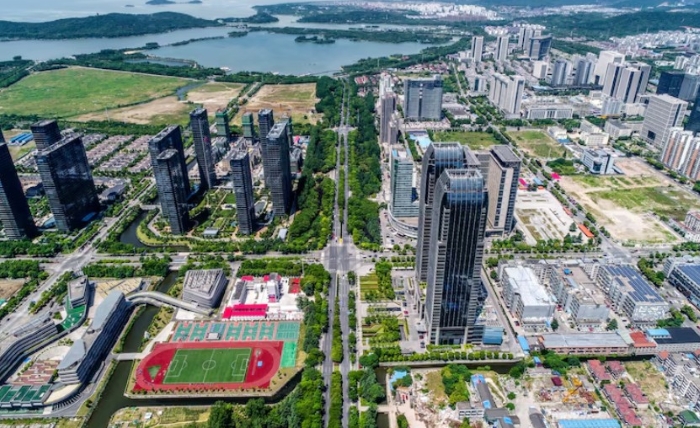
California is running out of room to grow outward. That is the short answer. The longer story involves decades of suburban sprawl, rising land costs, strict environmental regulations, and a housing shortage that continues to push families further from jobs and services.
The solution gaining serious traction across the state is urban infill development, a strategy that puts new housing on vacant, underused, or overlooked parcels inside existing neighborhoods rather than paving over open land on the metro fringe.
For buyers exploring new homes in southern California, this shift opens doors that did not exist five years ago.
Thoughtfully planned communities are appearing on former commercial lots, aging strip malls, and surplus industrial parcels, all within established suburbs that already have schools, parks, transit lines, and grocery stores nearby.
What Is Urban Infill Development and Why Does It Matter?
Urban infill development refers to building on land that sits inside an already developed area.
Think of it as filling gaps in an established neighborhood rather than extending the neighborhood’s borders. A vacant lot between a school and a fire station, a closed gas station on a busy corridor, or a parking lot behind a shopping center can all become sites for new homes, townhomes, or mixed- use projects.
The reason thisit matters is straightforward. California added roughly 2.5 million residents over the last decade but permitted far fewer housing units than demand required.
Prices climbed, commutes stretched, and younger buyers found themselves priced out of metro areas entirely.
Infill housing addresses this gap by creating supply where infrastructure already exists, which keeps construction costs lower, reduces the need for new roads or utility lines, and shortens the approval timeline compared to greenfield projects at the urban edge.
Where Is Urban Infill Is Taking Shape Across Southern California?
Several regions are seeing a surge of infill activity.
The Inland Empire, parts of Orange County, the San Gabriel Valley, and pockets of north Los Angeles County all have active or planned projects that convert underperforming commercial land into residential neighborhoods.
Builders are targeting corridors near transit stations, university campuses, medical centers, and employment hubs because those locations already draw daily foot traffic and spending.
Local governments are also doing their part. Senate Bill 9 and Senate Bill 10, passed in recent years, made it easier to split single family lots and rezone parcels near transit for higher density housing.
Cities like Ontario, Rancho Cucamonga, Pomona, and Fontana have updated general plans to encourage infill projects on aging commercial strips, surplus school district land, and underused municipal parcels.
What Are The Benefits for Buyers and Communities?
#1: Shorter Commutes, More Time at Home
When you buy a home inside an established suburb, you typically live closer to your workplace, your children’s school, medical offices, and daily errands.
That proximity translates to fewer miles driven, lower fuel costs, and more hours in the day to spend with your family or on activities you enjoy.
#2: Access to Existing Infrastructure
One of the strongest selling points of infill housing is location within a mature community. Sewer lines, water mains, electrical grids, broadband connections, fire stations, and public transit routes are already in place.
You are not waiting years for a new freeway on-ramp or a promised retail center that may or may not get built. The neighborhood is already there.
#3: Stronger Property Values Over Time
Infill projects tend to appreciate well because they sit in areas with limited remaining land. Once the last vacant parcels in a suburb are built out, supply becomes fixed while demand continues to grow.
Buyers who purchase early in an infill community often see strong equity gains as the surrounding area fills in and local retail, dining, and services follow the new rooftops.
What iIs Urban Infill Development in Practice?
Knowing what is urban infill development is on paper is one thing. Seeing it play out on the ground is another.
A practical example might look like a builder who acquires a 15- acre former nursery site bordered by single- family homes on two sides and a commercial plaza on the third.
Rather than proposing a dense apartment block, the builder designs a mix of detached single family homes and attached townhomes, adds landscaped setbacks along the existing neighborhood boundary, and includes a small pocket park.
The result is a community that adds housing supply without clashing with the established character of the area.
Successful infill builders also prioritize walkability, energy efficiency, and smart home features because today’s buyers expect more from a new home than four walls and a roof.
Solar panels, EV charging stations, water- saving fixtures, and open floor plans are standard in many of these projects, making these homes attractive to first- time buyers, young professionals, growing families, and downsizers alike.
What to Look for When Shopping Infill Communities?
If you are considering an infill community, keep a few things on your checklist.
- First, review the site’s history. A reputable builder will have completed environmental assessments and remediation if needed, so ask for documentation.
- Second, study the surrounding land uses. Proximity to transit, retail, schools, and healthcare adds long- term value and everyday convenience.
- Third, check the builder’s track record. Look for completed projects, buyer reviews, warranty terms, and a reputation for delivering on time.
- Fourth, consider community design. Well- planned infill neighborhoods include green space, pedestrian paths, and architectural variety that complement the existing streetscape.
A good project feels like a natural extension of the suburb, not an afterthought dropped onto a leftover lot.
The Road Ahead for California Housing
California’s housing conversation has shifted. The old model of building tract homes on distant farmland and asking buyers to endure two- hour commutes is losing ground.
Infill development offers a practical, community- friendly path forward because it respects the fabric of existing neighborhoods while adding the housing supply the state desperately needs.
For buyers who want to own a brand- new home without sacrificing location, infill communities represent one of the most promising opportunities in the Southern California market right now. The land is already here. The infrastructure is already here. And increasingly, the homes are too.
If you are ready to explore your options, start by researching active infill projects in your target area, visiting model homes, and talking to builders who specialize in this type of development.
The right home in the right location does not have to mean a long wait or a long drive. It might already be taking shape a few blocks from where you are right now.