
Every growing business reaches a point where its technology stops helping and starts holding it back. Orders take longer to confirm. Inventory counts disagree between systems. Support teams spend their day explaining why the app says one thing and the warehouse says another. Nothing has broken, exactly. The business has simply outgrown the assumptions its software was built on.
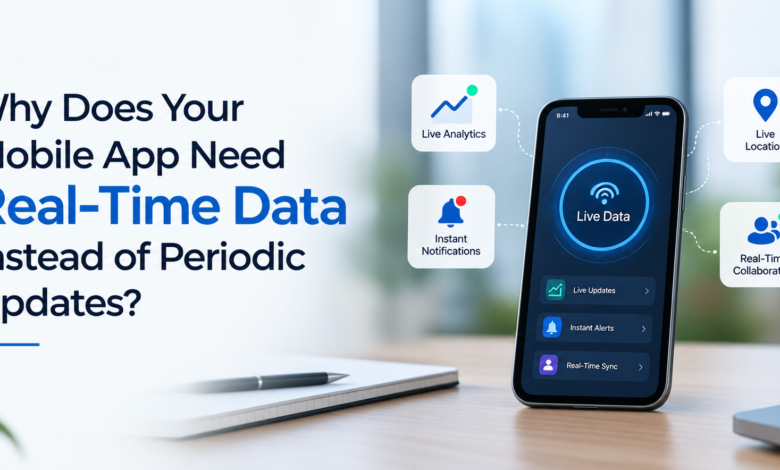
One of the most common of those assumptions is that data can wait. A large share of mobile apps still run on a periodic model: the app checks in every few minutes, pulls a batch of updates, and shows the user a picture of the business as it looked a short while ago. That was reasonable when apps were simple and transaction volumes were low. It becomes expensive at scale, which is why many companies revisit their approach to custom mobile app development services once growth exposes the gaps.
The cost of stale data is rarely one dramatic failure. It shows up as a slow leak. Double bookings. Refunded orders. A driver dispatched to an address that changed forty minutes ago. A fraud alert that lands after the transaction has already cleared. Each incident looks minor on its own, and together they set a quiet ceiling on how far the business can grow without hiring people to compensate for the software.
The conversation also runs wider than the app itself. Real-time behaviour depends almost entirely on what sits behind the screen, which is why leadership teams evaluating custom AI software development services usually find the real work is in the data layer rather than the interface.
What Enterprise-Grade Actually Means Here
Enterprise-grade is an overused phrase, so it helps to define it in practical terms. For a real-time app, five properties matter.
Scalability. A periodic app polls on a fixed schedule, so traffic rises in direct proportion to users. Ten times the users means ten times the requests, most of them returning no new information. Event-driven systems push updates only when something changes, so infrastructure cost tracks activity instead of headcount.
Security. Live data means live connections, and persistent connections need their own controls: token refresh, per-channel permissions, and rules that stop one customer’s stream from carrying another customer’s records. This is easier to design in at the start than to retrofit under audit pressure.
Performance. Users judge speed by the gap between an action and its visible result. Sub-second updates change behaviour. People stop refreshing, stop calling support to confirm, and start trusting the screen in front of them.
Reliability. Real-time systems have to fail gracefully. Connections drop on trains, in basements, and in rural coverage gaps. A well-built app queues local changes, reconnects quietly, and reconciles without losing work.
Integration. The app is one window into a wider estate of ERP, CRM, payment, and logistics systems. If those systems only exchange data on a nightly batch, the app cannot be truly live regardless of how it is coded.
The Pillars That Make Real-Time Sustainable
Modular architecture. A monolith couples everything to everything, so a change to the notification service risks the checkout flow. Microservices let a business scale the components that carry live traffic without paying to scale the rest. Monoliths are not always wrong, and for a small product they are often the sensible choice, but the boundaries need to be drawn early enough that separating services later is a project rather than a rewrite.
Cloud-native development. Real-time traffic is spiky. Managed streaming, autoscaling, and serverless functions absorb those spikes without a capital purchase, and they remove the temptation to over-provision hardware for a peak that arrives twice a year.
Data-driven decision making. Once events flow continuously, the business gains a live operational picture rather than a report about last week. Pricing, staffing, and stock decisions move from monthly review cycles to same-day adjustments.
Automation and AI readiness. Machine learning models are only as useful as the freshness of what they see. Fraud scoring, demand forecasting, and anomaly detection all depend on a stream of current events. Companies that build event pipelines now are effectively pre-paying for the AI capability they will want in two years.
Where Businesses Usually Go Wrong
A short-term development mindset. Budgets get approved against a launch date, not a three-year operating cost. The cheapest build often carries the highest total cost, because the architecture that ships in twelve weeks is the architecture the company will be paying to work around in eighteen months.
Deferring scalability until it hurts. Scalability is a design decision, not a feature to add later. Choices about how events are published, how state is stored, and how services communicate are difficult and expensive to reverse once real customer data is flowing through them.
Picking the wrong stack. Technology chosen because it was familiar to the first developer, or fashionable at the time, tends to become a hiring constraint. The right question is not which framework is best, but which one the business can staff, secure, and support for the next five years.
Best Practices for a Future-Ready Build
Start with a discovery phase that maps which data genuinely needs to be live. Not everything does. Order status, availability, location, and payment state usually do. Marketing content and historical reporting usually do not. Being selective keeps infrastructure costs sane and focuses engineering effort where it changes commercial outcomes.
Choose a development partner who asks about your operations before they ask about your feature list. The useful early conversations are about failure modes, integration constraints, and support load, not screen counts.
That framing is where firms such as NewAgeSysIT tend to begin, assessing how data actually moves through a business before recommending any rebuild. The company is based in New Jersey and works primarily with clients across the United States, focusing on enterprise systems where accuracy and uptime carry direct commercial consequences. Its custom mobile application development engagements typically start at the data layer, on the reasoning that a fast interface over slow data solves nothing.
Finally, treat launch as a starting line. Instrument the app, watch where latency and errors cluster, and iterate against evidence rather than opinion.
What This Looks Like in Practice
Consider a regional distributor running a field sales app on hourly syncs. Reps quoted from stock figures up to sixty minutes old, so roughly one order in twelve had to be amended after the fact. Each amendment consumed staff time in three departments and eroded customer confidence.
Moving inventory to an event stream, so that every warehouse movement published a change immediately, cut those amendments sharply within a quarter. The architecture change also delivered something unplanned: with live movement data available, the operations team could finally see demand patterns as they formed rather than in a month-end report.
The Long View
Periodic updates are not a bug. They are a design choice that made sense under a set of conditions most growing businesses eventually leave behind. The question worth asking is not whether the current app works, but whether its architecture will still make sense at three times the volume.
Businesses that invest in real-time, well-architected systems buy more than speed. They buy the ability to add products, regions, and partners without a rebuild each time, and they position themselves to adopt automation and AI when the case becomes clear. That optionality is difficult to price on a project quote, and it is usually the difference between technology that supports growth and technology that quietly caps it.