The easiest way to misunderstand AI music is to judge it only by the first result. A user enters a prompt, gets a song, and then decides whether the platform “works.” But music, even in assisted form, rarely reveals its full value through one output. The more honest test is whether the tool helps a person move from one version to a better version with greater clarity each time. By that standard, ToMusic is more interesting as an iteration system than as a simple song machine.
That distinction matters because real creative work is usually comparative. A creator listens, notices a mismatch, changes the brief, tries again, compares versions, and gradually gets closer to the intended result. Platforms that support that cycle tend to become useful. Platforms that focus only on the surprise of generation tend to feel shallower over time. An AI Music Generator becomes most durable when it gives users not just outputs, but a workable path from rough output to stronger output.
ToMusic is built in a way that supports this reading. The platform offers four models, accepts descriptive prompts or custom lyrics, stores results in a cloud library, and explicitly frames re-generation as normal. Taken together, those choices make it feel less like a vending machine for songs and more like a workspace for repeated musical decision-making.
Why Iteration Is The Real Center Of AI-Assisted Music
Most creative frustration does not come from having no output at all. It comes from almost having the right output. A track is close but too dramatic. A chorus is catchy but too crowded. The voice fits but the arrangement does not. The energy is right but the texture is wrong. These are revision problems, and they define much of the user experience.
ToMusic supports this kind of work because it allows the user to refine prompts, switch models, edit lyrics, and compare results instead of treating each generation as an isolated event. That is a quietly important design decision.
Why The First Draft Is Usually A Diagnostic Tool
The first version often reveals what the user actually meant more clearly than the original prompt did. This is useful because it turns abstract intent into something specific enough to revise.
Why Comparison Sharpens Taste
Taste develops when people can place multiple versions side by side and ask which one carries the right emotional logic. Iteration is how that happens.
Why Repetition Is Not A Failure State
In generative music, needing another version is often a feature of the process, not evidence that the tool missed the point entirely.
How ToMusic Supports Iterative Decision-Making
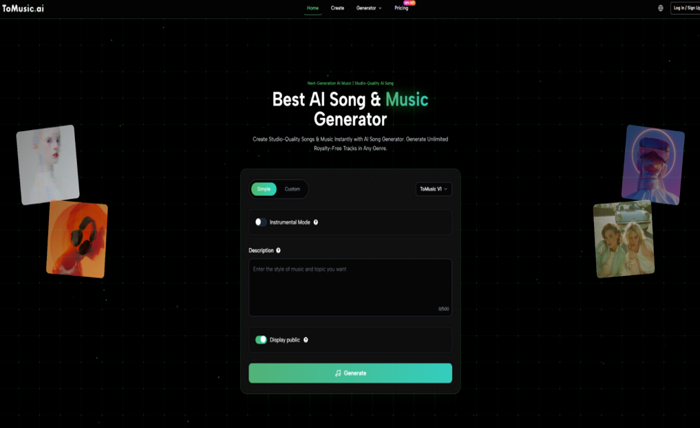
The platform’s generation process is simple on the surface, but underneath it encourages revision in several ways. It gives users multiple models, allows simple or custom mode, supports vocal and instrumental output, and saves results in a persistent library. These features work together to make change possible.
Instead of forcing the user to restart from nothing each time, the product allows them to build from previous attempts, whether that means changing the prompt, trying a different model, or hearing the same lyrics in a new musical frame.
Why The Four Models Create Useful Contrast
Model contrast is one of the strongest iteration tools in the platform because it lets users learn from differences rather than from guesswork.
Model | Iteration Value | What A User Can Learn |
V1 | Fast comparison baseline | Whether the core idea works at all |
V2 | Tonal and atmospheric variation | Whether mood needs more depth |
V3 | Structural and harmonic variation | Whether complexity helps or hurts |
V4 | Vocal and control-focused variation | Whether performance changes the result |
This makes model choice more than a technical preference. It becomes a revision method. A user can discover that the problem was not the lyric but the model. Or not the mood but the arrangement density. Or not the concept but the vocal treatment.
A Three-Step Workflow That Encourages Better Revisions
The official use flow is direct enough that it does not interrupt the revision cycle.
Step 1. Choose The Model And Initial Input
The user starts by selecting a model and deciding whether to enter a descriptive prompt or custom lyrics. This creates a first version of the idea.
Step 2. Generate From The Current Brief
The platform interprets the musical instruction using genre, mood, tempo, instrumentation, voice characteristics, and other relevant signals supplied by the user.
Step 3. Review, Save, And Regenerate With Purpose
The output is stored in the music library, where it can be revisited and compared. At that point, the user can change one variable and generate again more intentionally.
Why Small Prompt Changes Matter More Than Users Expect
A good iteration system does not only support large changes. It also rewards small ones. In ToMusic, a revised tempo phrase, a sharper mood descriptor, a clearer instrumentation note, or a more precise voice instruction can shift the resulting track significantly.
This matters because users often think revision means rewriting everything. In practice, the most effective improvements may come from controlled adjustments. The platform is particularly useful when approached this way: change one major dimension, hear the difference, and decide whether the idea moved closer to the target.
Why Mood Refinement Often Changes Everything
An output described as uplifting may need to become restrained, reflective, bittersweet, or more cinematic. Those are small textual shifts with large musical consequences.
Why Instrumentation Clarifies Identity
Adding clearer instrumental direction often stops the result from drifting into a more generic space. It anchors the sound world.
Why Voice Direction Is A Hidden Revision Lever
When vocals are involved, changing the voice feel can transform how the entire track reads emotionally.
How Lyrics-Based Generation Becomes An Iteration Loop
The platform’s lyrics support makes revision even more interesting. Lyrics to Music AI is not only a way to turn words into a song. It is a method for hearing what the words need next.
A writer can generate a version, hear that the chorus is too wordy, reduce the line density, try again, and compare the emotional effect. Or the lyrics may be fine, but the style frame may be wrong. In that case, the writer can keep the text and revise the musical direction. The product supports both kinds of iteration.
Why Lyrics Reveal Problems Faster Than Silent Reading
Hearing words sung exposes pacing issues, awkward phrasing, and weak transitions immediately. That makes revision more concrete.
Why This Helps Beyond Songwriting
Teams creating jingles, hooks, educational songs, or campaign phrases can use the same loop. They do not need final music immediately. They need to know whether the words survive performance.
Why The Best Result May Be The Third Or Fifth Try
The value lies in the path, not only in the first output. Sometimes the strongest version appears only after several controlled changes.
Why The Music Library Is Central To The Workflow
ToMusic’s cloud library may be one of the most underrated parts of the platform because iteration depends on memory. If earlier versions disappear, comparison becomes guesswork. If prompts, lyrics, titles, and parameters remain attached to saved outputs, the user can actually learn from the process.
That archive turns revision into a visible sequence. It lets the user understand which prompt adjustments worked, which model choices improved the track, and which earlier version should remain the reference point.
Why Saved History Improves Decision Quality
Without saved context, users may confuse novelty with improvement. With saved context, they can judge whether the new version is genuinely better or simply different.
Why This Makes The Platform Feel More Professional
A workspace that remembers prior attempts encourages deliberate refinement instead of random generation.
Where The Platform’s Limits Still Need To Be Respected
Even a good iteration system cannot guarantee that every revision will improve the track. Some prompts remain too broad. Some ideas may simply need stronger lyrical writing or a different emotional approach. Certain outputs may sound promising at first but weaken on repeated listening. Human judgment is still necessary at every stage.
That is why ToMusic works best when treated as a partner in narrowing options rather than a machine that automatically discovers the perfect answer. The platform provides motion. The user provides direction.
Why More Generations Do Not Automatically Mean Better Results
Iteration only becomes valuable when the changes are intentional. Randomly generating again may produce variety, but purposeful revision is what creates progress.
Why Users Still Need Editorial Discipline
At some point, better prompting gives way to selection. The user must decide which version best serves the song, the message, or the project.
Why This Is A Good Constraint
A platform remains more believable when it supports human taste instead of claiming to replace it.
Why ToMusic Makes More Sense On The Second Listen Than The First
The first output from ToMusic may impress or disappoint depending on the prompt, the model, and the user’s expectations. But the product’s deeper value often appears later, when the user begins comparing versions, adjusting variables, saving stronger drafts, and noticing patterns. That is when it starts to function as a real creative system instead of a novelty tool.
Seen this way, ToMusic is less about instant song delivery and more about guided convergence. It helps users move toward the right track through repeated listening and revision. In music, that is often how real progress happens anyway. The platform simply compresses the time between one decision and the next. And for many creators, that compression is the most useful form of creative assistance it can offer.