
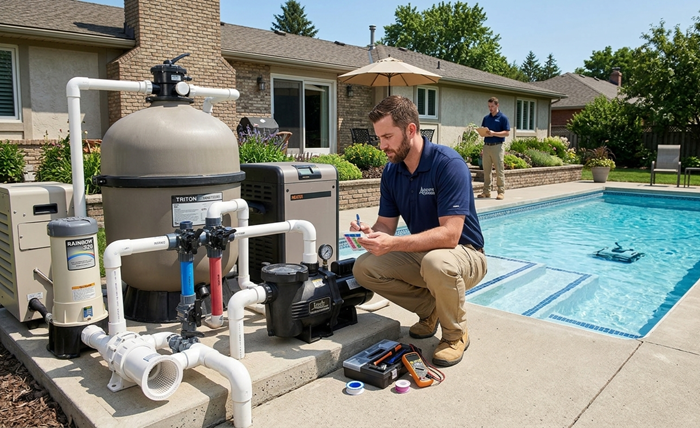
Pool repair work looks straightforward from the outside. You show up, diagnose the problem, fix it, and move on. But the liability exposure attached to that work is anything but simple.
Contractors who specialize in pool repair face a combination of property damage risk, worker injury exposure, and client-side liability that most general commercial policies aren’t built to handle. For contractors serious about protecting what they’ve built, insurance for pool repair contractors needs to be structured around the actual work, not adapted from a policy designed for a different trade.
What Makes Pool Repair Risk Different From General Contracting
A general contractor builds something new. A pool repair contractor works on something that already exists, often something that’s been in use for years, in someone’s backyard, around their family.
That context changes everything about the liability picture.
When you’re repairing a cracked pool shell, replacing aging plumbing fittings, or servicing pool equipment near a water-filled structure, the margin for error is tight. A repair that holds for three months and then fails during peak summer use isn’t just a warranty problem. It’s a property damage claim, possibly a bodily injury claim, and a reputational hit all at once.
Pool repair contractors also work across a wider range of scenarios than most trades: above-ground pools, in-ground pools, spas, hot tubs, and commercial aquatic facilities, each with its own structural quirks and client expectations.
Quick Read: Pool repair contractors carry a distinct liability profile because they work on existing structures with active users. A failed repair doesn’t just create a warranty dispute. It creates a chain of property, injury, and liability exposure that standard contractor policies often miss entirely.
The Job Site Risks That Show Up Most Often
Before any post-repair liability comes into play, there’s the work environment itself.
Pool repair jobs regularly involve confined space access, chemical handling, electrical systems near water, and heavy equipment like pumps and filters. Each of those elements introduces a separate injury risk for workers and a separate damage risk for client property.
Workers’ compensation is non-negotiable for any pool repair business with employees. The injury scenarios in this trade, chemical exposure, electrical contact near water, musculoskeletal strain from working in tight mechanical spaces, are serious enough that a single claim without adequate coverage can threaten the financial stability of a small operation.
On the property damage side, third-party general liability coverage needs to reflect the actual value of what contractors are working around. A high-end residential pool with integrated spa and automated controls represents significant asset value. If surrounding decking, landscaping, or equipment is damaged during a repair job, the claim amount will reflect the replacement cost of those assets, not just the scope of work being done.
Note: Workers’ compensation and general liability form the base layer of any pool repair risk plan. Both need to be sized for the real-world scenarios this trade produces, not set at minimum limits and left unreviewed.
Equipment, Materials, and the Coverage Gaps Between Jobs
Pool repair contractors carry significant inventory between job sites: pumps, filters, plumbing components, plaster materials, and diagnostic tools. That equipment is vulnerable when it’s in a vehicle, staged at a job site, or stored at a shop.
Standard commercial property policies cover items at a fixed business location. They don’t extend to tools and materials in transit or temporarily stored at a client’s property. That gap is where inland marine coverage steps in.
For pool repair contractors who move high-value equipment regularly, inland marine isn’t optional. A vehicle break-in or a job site theft can strip a contractor of thousands of dollars in tools and materials. Without inland marine coverage, that loss comes directly out of the business.
Commercial auto coverage is the other piece that gets overlooked. Using a personal vehicle for business purposes, even occasionally, voids most personal auto policies in the event of a work-related accident. Any vehicle used to transport equipment, materials, or workers to pool repair jobs needs commercial auto coverage.
Building a Coverage Structure That Matches the Work
A risk plan built for pool repair contractors typically includes these core components:
- General liability for third-party bodily injury and property damage at client sites
- Workers’ compensation covering all employees across the full range of job classifications
- Inland marine for tools, equipment, and materials in transit or off-premises
- Commercial auto for all vehicles used in the course of business
- Excess liability to extend limits above primary coverages for higher-value commercial jobs
- Equipment breakdown for owned pumps, diagnostic tools, and mechanical equipment
Pool plasters and contractors working on spa and hot tub systems have additional nuances in their coverage needs, particularly around completed operations liability, which addresses claims that arise after a job is finished and the contractor has left the site.
Completed operations coverage is where many pool repair contractors are most exposed. If a repair fails weeks after completion, standard general liability may respond differently depending on how the policy is written. This is why working with a program built for the pool industry matters.
Key Takeaway: A complete pool repair risk plan layers general liability, workers’ comp, inland marine, commercial auto, and excess liability. Completed operations coverage is the piece most often missing from generic policies and most relevant to how pool repair claims actually develop.
FAQs
What insurance does a pool repair contractor need?
Pool repair contractors need general liability, workers’ compensation, inland marine, and commercial auto at minimum. Completed operations liability is also important, as many claims in this trade arise after the job is finished. Contractors working on commercial facilities or high-value residential properties should also carry excess liability.
Does general liability cover damage caused by a pool repair that fails later?
It depends on how the policy is written. Completed operations coverage, which is a component of general liability, specifically addresses property damage or injury that results from finished work. Not all policies include this at adequate limits. Pool repair contractors should confirm this is explicitly covered and not assumed.
Why do pool repair contractors need inland marine insurance?
Inland marine covers tools, equipment, and materials when they’re away from a fixed business location, in a vehicle, staged at a job site, or in temporary storage. Standard commercial property policies don’t extend to those scenarios. For contractors regularly transporting pumps, plaster materials, and diagnostic equipment, that gap represents real financial exposure.
Is workers’ compensation required for pool repair businesses?
Yes, in most states, any business with employees is legally required to carry workers’ compensation. Pool repair work involves injury risks including chemical handling, electrical exposure near water, and physically demanding work in confined mechanical spaces. A single serious injury without adequate workers’ comp coverage can generate costs that exceed what most small businesses can absorb.