Somewhere in a storage box under my bed, there is a ceramic tile from Lisbon, a miniature Eiffel Tower with a broken tip, two keychains I have never used, and a snow globe from Vienna that stopped working before I made it through customs. I know they are there. I have not looked at them in three years.
At some point during my ninth trip abroad, I made a quiet decision: I was done buying things from souvenir shops. I cared too much about travel to keep filling a box with objects that had nothing to do with me or anything that actually happened on those trips.
The instinct to bring something home is deeply human. The problem is that the souvenir industry has mostly given up on making anything personal.
The Gap Between What You Experienced and What You Can Buy
Think about the moments you actually remember from a trip. Not the landmark you photographed from fifty meters back with a crowd in the foreground. The moment your partner laughed so hard on a cobblestone street that they had to sit down. The spontaneous portrait a stranger offered to take of your whole group outside a market you had wandered into by accident.
Those moments exist as photos on your phone. But nothing in any airport gift shop reflects them. Everything there was made before you arrived and will still be there after you leave, unchanged, for the next ten thousand visitors.
That gap between the specific thing that happened to you and the generic object available for purchase is where most souvenir regret lives.
What Changed When I Tried a Custom 3D Relief Badge
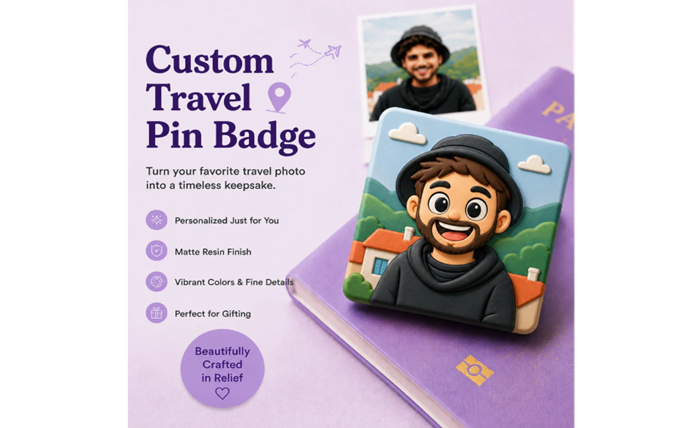
A travel journalist I follow mentioned offhandedly that she had started ordering personalized travel souvenir pins from SnapFig after each major trip — specifically their Custom 3D Relief Badge, which converts a personal photo into a sculpted resin pin with genuine dimensional depth. I was skeptical in the way you are skeptical of anything that sounds like it solves a problem you have convinced yourself is unsolvable.
I uploaded a photo from a hiking trip: two of us at the top of a ridge, backlit by late afternoon light, visibly exhausted and visibly happy. The kind of photo that gets a lot of likes and then disappears into an archive.
What came back was that photo — but physical. Not printed flat on a button. Sculpted. The faces had actual relief. The background had depth. It looked like something a craftsperson had spent time on, except the process had been driven by AI modeling from my own image file.
It now sits on my desk. I look at it every day. I have not looked at the ceramic tile from Lisbon in three years.
Why the 3D Element Changes Everything
There is a specific reason the relief format works better than a standard photo print or flat pin, and it comes down to how we perceive objects versus images.
A printed photo is still a screen. It is a flat rectangle that your brain processes the same way it processes a thumbnail. You see it, recognize it, and move on. A sculpted object with depth and texture engages differently. You notice it catches light at different angles throughout the day. You want to pick it up. It registers as a thing in the world rather than a representation of a thing.
For a custom 3D photo pin, this distinction matters enormously. The same image that would be forgettable as a print becomes genuinely compelling as a relief badge because the dimensional form forces your brain to engage with it as an object rather than a file.
This is not a small difference. It is the difference between a souvenir that ends up in a box and one that earns a permanent place on your shelf, your jacket, or your travel bag.
The Trip You Have Not Taken Yet
One shift in how I think about travel photography now: I am more deliberate about capturing the photo I want to turn into a badge before the trip ends.
It sounds calculated, but it is actually the opposite — it forces you to notice the moments worth capturing. Not the posed shots in front of monuments. The real ones. The personalized travel souvenir pin badge you end up ordering becomes a kind of editorial decision about what the trip actually meant to you.
Some practical notes from doing this across a few trips now:
- Natural light portraits convert into the cleanest relief designs. Golden hour shots with clear subject separation from the background work especially well.
- Group shots of two or three people work. Larger groups lose individual detail at badge scale.
- Landscapes alone are less interesting as relief badges than portraits with a landscape behind them. The human element gives the depth map something to anchor to.
- Pet photos — particularly dogs on outdoor adventures — produce some of the best results. The texture of fur translates beautifully into resin relief.
- If you want a version for the kitchen rather than the jacket, the same image can be rendered as a custom resin fridge magnet — same 3D relief quality, different mounting format.
On Giving These as Gifts
I have started ordering a second badge for anyone who was with me on a trip. It costs very little extra and lands completely differently than any other gift I have given travel companions.
There is something about receiving an object that says: you were here, this happened, and I thought it was worth making permanent. It is a fundamentally different message than a shared album link or even a framed print. The photo relief badge maker format — small, wearable, tactile — makes it easy to keep and hard to forget.
For a couple’s trip, a honeymoon, an anniversary journey, or a milestone adventure shared with friends, a custom relief pin badge functions as the kind of AI personalized travel gift that people actually keep rather than politely acknowledge and quietly shelve.
Mixing Analog and Digital in a Travel Memory System
For the last two trips, I have been building what I loosely call a travel memory system: a physical shelf that holds a relief badge from each major journey alongside a small printed photo card and a handwritten note about one thing I want to remember from that trip.
It takes maybe twenty minutes per trip to assemble, and the result is a shelf that tells a coherent story of the last few years in a way that no digital gallery quite manages. There is something about the physicality of it — the mix of textures, the different scales, the way objects cast shadows on each other — that makes the whole more meaningful than any single component.
If you want to think more carefully about the role of physical media in preserving travel memories, a recent hands-on review exploring how the Fujifilm Instax Mini Evo Cinema compares to earlier instant print formats covers the analog-versus-digital tension in interesting detail — useful context if you are building a similar system that mixes printed and crafted physical keepsakes.
The Only Souvenir Rule That Has Ever Made Sense to Me
If you cannot look at it in ten years and immediately know where it came from and why it mattered — it is not worth the space it takes up.
A mass-produced ceramic tile fails that test on arrival. A custom relief badge of you and your partner at the top of a mountain you actually climbed passes it for life.
The storage box under my bed is not getting any new additions. But the shelf above my desk has one more object on it now, and it earns its place every single day.